
Regulators and fines
Settlements without admission explained
Short answer
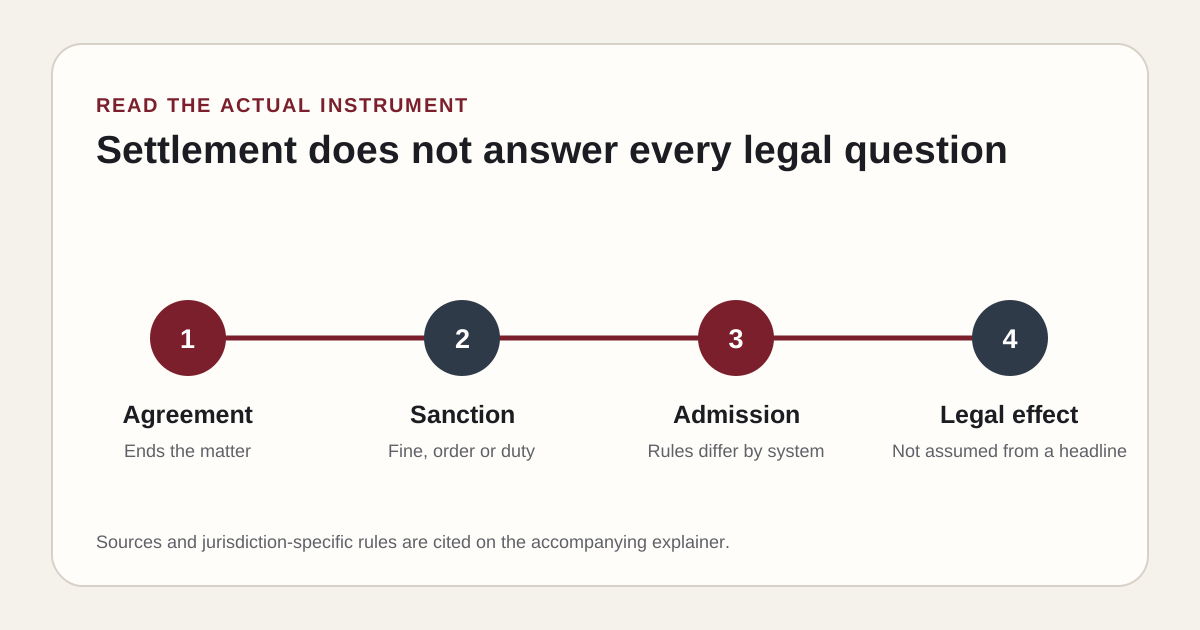
A settlement resolves the case on agreed terms 1.
The instrument states the payment, restriction or other obligation 1,34,5.
SEC, FCA, EU, ASIC and French procedures do not use one uniform admissions rule 1,34,56.
A settlement without admission is not the same as a court declaration of guilt 1,6.
- SEC no-deny rule
- Rule 202.5(e), adopted 1972, rescinded by a final rule signed 18 May 2026, published and in effect 21 May 2026 1
- SEC rule status
- 17 CFR 202.5(e) now shown as reserved 2
- FCA settlement discount
- 30% if agreed during stage 1, 0% otherwise 3
- EU cartel settlement reduction
- 10% of the fine, after the 10% cap 4
- ASIC undertakings
- Admissions required as a rule when accepted in final resolution of a matter 5
- France CJIP
- Validation order is not a declaration of guilt 6
What the phrase means
In a settlement without admission, the regulator and the other party agree an outcome without a contested finding of liability. The order or agreement records the sanction. The settling party does not admit the allegations. The SEC described its position in May 2026 as discretion to settle with defendants who decline to admit facts or liability 1.
A settlement of this kind is not an acquittal. It is not a finding that the conduct did or did not happen. It is a negotiated end to that proceeding. At the SEC, a civil or administrative settlement may not extend to any criminal charges, which are for the Attorney General and the Department of Justice 2.
United States: the SEC's 2026 change
From 1972 the SEC's Rule 202.5(e) said the Commission required a defendant or respondent to agree not to publicly deny the allegations before it would settle a case that imposed a sanction. It was known as the no-deny or gag policy 1. On 18 May 2026 the Commission signed a final rule rescinding Rule 202.5(e). The rule was published in the Federal Register on 21 May 2026, at 91 FR 29892, and took effect that day 1. The current eCFR text of 17 CFR 202.5 shows paragraph (e) as reserved and lists an amendment at 91 FR 29896 dated 21 May 2026 2. The change is live.
The Commission said the harm to the public interest from denials may be minimal, and gave four further reasons. The policy's only remedy was to ask a court to vacate a settlement or to reopen a proceeding, and the SEC knew of no case where it had sought that after a breach. Social media made it hard to tell which statements were public denials. Most other federal agencies have no similar rule. Rescission gives more flexibility to settle 1. The SEC said it will not enforce no-deny provisions in settlements already entered 1. The release says the change does not affect the SEC's discretion to settle with defendants who decline to admit facts or liability, and the SEC can still negotiate for admissions. Where a defendant in a parallel criminal case has pleaded or been convicted, the SEC may still address admissions and denials in the settlement 1.
United Kingdom: FCA settlement and the discount
The FCA can agree a penalty with a firm or person. Agreement during stage 1 brings a 30% reduction in the penalty. Agreement at any later point brings 0% 3. Stage 1 runs from the start of the investigation until the FCA has a sufficient understanding of the nature and gravity of the breach, has communicated its assessment of the penalty and has given a reasonable opportunity to reach agreement 3.
In a focused resolution agreement, some issues are agreed and others go to the decision maker. The reduction is 30% where all facts and the breach are agreed, 15% to 30% where all facts are agreed, and 0% to 30% in other cases, each for agreement during stage 1 3. No discount applies to disgorgement or to a permanent disciplinary prohibition 3.
European Union: cartel settlements need an acknowledgement
The European Commission's cartel settlement procedure dates from a 2008 notice. A settlement submission must contain an acknowledgement in clear and unequivocal terms of the parties' liability for the infringement 4. In return the Commission reduces the fine by 10% after the 10% turnover cap has been applied 4.
The Commission keeps a broad margin of discretion over which cases suit settlement 4. If its statement of objections does not reflect a party's settlement submission, that party is no longer bound by the submission 4.
Australia and France: two other models
In Australia, ASIC can accept a court enforceable undertaking under the ASIC Act 5. When an undertaking is accepted in final resolution of a matter, ASIC will as a rule require admissions that the party contravened specific provisions. As a rule it will not accept a clause denying liability 5. Accepted undertakings go on a public register and stay there after the obligations are met 5. If ASIC believes a term has been breached, it may apply to the court for orders, which can include compensation for people who suffered loss 5.
In France, a convention judiciaire d'intérêt public lets a company pay a public interest fine of up to 30% of its average annual turnover over the last three years 6. The order validating it does not amount to a declaration of guilt and is not entered on the criminal record 6.
Terms that are easy to confuse
- Neither admit nor deny: the party accepts a sanction without admitting the allegations. Since May 2026 SEC settlements no longer need a promise not to deny them in public 1.
- Admission: the party accepts facts or liability on the record. ASIC as a rule requires admissions when it accepts an undertaking in final resolution of a matter 5.
- Acknowledgement of liability: a required part of an EU cartel settlement submission, in return for a 10% reduction 4.
- Validated agreement without conviction: the French model, where the validation order is not a declaration of guilt 6.
Common questions
Does settling with the SEC mean admitting guilt?
No. The SEC can settle with parties who decline to admit facts or liability. Since May 2026 it no longer requires them to agree not to deny the allegations in public 1.
What was the SEC gag rule?
Rule 202.5(e), adopted in 1972, barred settlements imposing a sanction where the party did not agree to refrain from publicly denying the allegations. The SEC rescinded it in May 2026 1.
Can a regulatory settlement stop a criminal case?
Not at the SEC. A civil or administrative settlement may not extend to any criminal charges 2.
How much discount does the FCA give for settling?
30% if agreement is concluded during stage 1, otherwise 0%, with set ranges for focused resolution agreements 3.
Rules and charges change. Check the official source linked on this page before you pay or travel. Spotted an error? Email hello@enforcementoutcomes.com.
Sources
- Federal Register, Vol. 91, No. 98: Securities and Exchange Commission, Rescission of Policy Regarding Denials in Settlements of Enforcement Actions (21 May 2026)
- eCFR: 17 CFR 202.5, Enforcement activities
- Financial Conduct Authority: FCA Handbook, DEPP 6.7 Discount for early settlement
- European Commission: Commission Notice on the conduct of settlement procedures in view of the adoption of Decisions pursuant to Article 7 and Article 23 of Council Regulation (EC) No 1/2003 in cartel cases (2 July 2008)
- ASIC: Regulatory Guide 100, Court enforceable undertakings (November 2021)
- Agence française anticorruption: La convention judiciaire d'intérêt public (April 2019)
Related
- SEC enforcement outcomes
What the US SEC reported for fiscal years 2025 and 2024: enforcement actions, monetary relief, bars and investor distributions, and how an SEC case moves.
- FCA enforcement outcomes
UK Financial Conduct Authority enforcement data for 2025/26 and 2024/25: outcomes, fines, convictions, operations closed, case durations and notices.
- How regulatory fines are calculated
How the UK FCA, the European Commission, the UK ICO and US federal courts set fines, from starting points to legal caps and settlement discounts.
- Deferred prosecution agreements explained
How deferred prosecution agreements work in the UK, the US, Canada and France, what a court approves, and what happens on completion or breach.
- How civil lawsuits usually end
Most civil cases end without a trial. Official US federal court and England and Wales County Court figures on settlements, defaults and trials.