
Regulators and fines
Sanctions listing and delisting: how a name comes off a list
Short answer
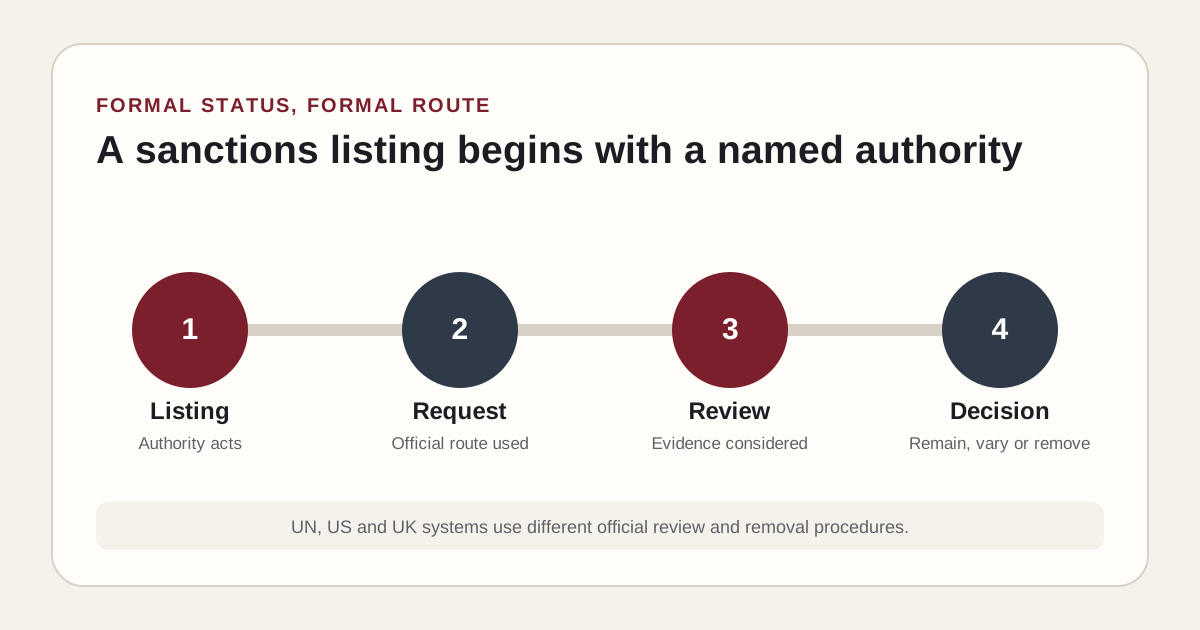
A UN committee, the US Treasury or a UK Minister places a person or entity on a list 1,35.
Each system provides its own petition or review procedure 1,34,5.
The designated person follows the official route for the relevant list 1,34,5.
The competent authority decides under its rules, with court review available in the UK route 5,6.
- UN Ombudsperson created by
- Security Council resolution 1904 (2009) 1
- UN Ombudsperson petitions accepted
- 116 2
- UN Ombudsperson petitions granted and denied
- 73 granted, 36 denied 2
- Delisted through UN Ombudsperson cases
- 68 individuals and 28 entities 2
- US legal basis
- 31 C.F.R. 501.807 3
What a listing is and is not
Sanctions lists are kept by different bodies. The UN Security Council keeps the ISIL (Da'esh) and Al-Qaida Sanctions List 1. The US Treasury's Office of Foreign Assets Control (OFAC) keeps its own lists 3. In the UK, a Minister makes designations under regulations made under the Sanctions and Anti-Money Laundering Act 2018 5.
The bodies that decide listings are a Security Council committee, a Treasury office and a Minister, not courts 1,35. Removal is called delisting in UN usage and revocation of a designation in UK law 1,5. A UK court can review a decision on a request to vary or revoke a designation, applying the principles of judicial review 6.
- Listing or designation: a body names the person or entity for sanctions measures 1,5.
- Delisting petition: a request to the listing body to remove the name 1,3.
- Denial: the request is refused. OFAC sends a determination letter 3.
- Court review: in the UK, an application to the High Court, or the Court of Session in Scotland, to set a decision aside 6.
United Nations: the Ombudsperson
The Office of the Ombudsperson was established by Security Council resolution 1904 (2009). It reviews requests from individuals, groups, undertakings or entities seeking removal from the ISIL (Da'esh) and Al-Qaida Sanctions List 1. The Ombudsperson gathers information, interacts with the petitioner and relevant States and organizations, and presents a report with a recommendation to the Sanctions Committee. The Ombudsperson then communicates the Committee's decision to the petitioner 1.
The UN page says the current mandate expires on 17 June 2027 1.
How UN Ombudsperson cases ended
The Status of Cases page shows no as-of date. Its latest entry is Case 116, which started on 31 July 2026 2. The figures below are copied from that page.
| Measure | Figure |
|---|---|
| Petitions accepted since the office was established 2 | 116 2 |
| Petitions with proceedings complete 2 | 114, including one withdrawn case and four rendered moot 2 |
| Cases concluded through the Ombudsperson process 2 | 109 2 |
| Petitions granted 2 | 73 2 |
| Petitions denied 2 | 36 2 |
| Individuals and entities delisted 2 | 68 individuals and 28 entities 2 |
| Cases rendered moot before the process was completed 2 | 4 2 |
| Requests pending 2 | 2 2 |
United States: an OFAC petition
OFAC reviews delisting petitions under 31 C.F.R. 501.807. A petition must argue a change in circumstances or an insufficient basis for the listing. Where a listing rests on more than one sanctions authority, the petition must meet the removal criteria for each one 3. OFAC says proposed remedial steps alone do not establish a change in circumstances 3.
Petitions go through the OFAC Reconsideration Portal 3. OFAC aims to finish a completeness review within 7 to 10 business days and then sends a Petition ID or asks for missing information 3. It typically sends a first questionnaire within 90 days of opening a petition. Failing to answer, or to answer truthfully and completely, may lead to denial 3.
OFAC gives no fixed overall timeline and says the process can be lengthy 3. If a petition is granted, the name is removed and public notice appears on the Recent Actions page and in the Federal Register. If it is denied, a new petition needs new arguments or evidence 3. People mistaken for a listed person are directed to the OFAC Compliance Hotline, not the petition process 3.
United Kingdom: a request to vary or revoke
Under section 23 of the Sanctions and Anti-Money Laundering Act 2018, a designated person may ask the Minister to vary or revoke the designation at any time the designation has effect. The Minister must decide whether to vary or revoke it or to take no action 5. A further request is allowed only if it raises a significant matter the Minister has not previously considered 5.
Section 22 says the Minister may vary or revoke a designation at any time, and must revoke it where the Minister considers the required conditions are not met 5. The periodic review duty in section 24 was removed by the Economic Crime (Transparency and Enforcement) Act 2022 from 15 March 2022 5.
For a person named by the UN, section 25 lets the person ask the Secretary of State to use best endeavours to secure removal of the name from the UN list 5. The Foreign, Commonwealth and Development Office publishes a review request form for designated persons and UN listed persons 4. Under section 38, a court reviewing a decision applies the principles of judicial review 6.
Common questions
Is being on a sanctions list a criminal conviction?
No court decides the listing. It is decided by a listing body such as the UN Sanctions Committee, OFAC or a UK Minister 1,35. UK law lets a court review such a decision on judicial review principles 6.
How do I get removed from the OFAC SDN list?
OFAC says a petition under 31 C.F.R. 501.807 goes through its Reconsideration Portal and must show a change in circumstances or an insufficient basis for the listing 3.
How long does OFAC delisting take?
OFAC gives no fixed timeline. It aims to finish a completeness review within 7 to 10 business days and typically sends a first questionnaire within 90 days 3.
How many UN delisting petitions succeed?
The UN Ombudsperson page reports 73 petitions granted and 36 denied, among 109 cases concluded through the Ombudsperson process 2.
Can a UK sanctions designation be challenged in court?
Yes. Section 38 of the Sanctions and Anti-Money Laundering Act 2018 lets the appropriate person apply to the High Court, or the Court of Session in Scotland, to set aside a decision 6.
Rules and charges change. Check the official source linked on this page before you pay or travel. Spotted an error? Email hello@enforcementoutcomes.com.
Sources
- United Nations Security Council: Ombudsperson to the ISIL (Da'esh) and Al-Qaida Sanctions Committee (undated)
- United Nations Security Council: Status of Cases (undated)
- Office of Foreign Assets Control: How to Request Removal from an OFAC Sanctions List (undated)
- Foreign, Commonwealth and Development Office: Sanctions Review Request Form: designated persons and UN listed persons (7 July 2020, updated 28 February 2023)
- legislation.gov.uk: Sanctions and Anti-Money Laundering Act 2018, Part 1, Chapter 2, Revocation, variation and review of designations
- legislation.gov.uk: Sanctions and Anti-Money Laundering Act 2018, section 38, Court review of decisions
Related
- What a regulatory investigation means
An investigation is not a finding. How the SEC, the UK FCA and the European Commission open, run and close investigations, with official figures.
- Appeals and overturned decisions
What affirmed, reversed, remanded and quashed mean, and how often appeals succeed in US federal courts, the EU Court of Justice and English criminal cases.
- Filed, charged and convicted: what each word means
A filed lawsuit, a criminal charge and a conviction are different stages. Official definitions from US and UK courts and prosecutors.
- How regulatory fines are calculated
How the UK FCA, the European Commission, the UK ICO and US federal courts set fines, from starting points to legal caps and settlement discounts.