
Courts and lawsuits
Filed, charged and convicted: what each word means
Short answer
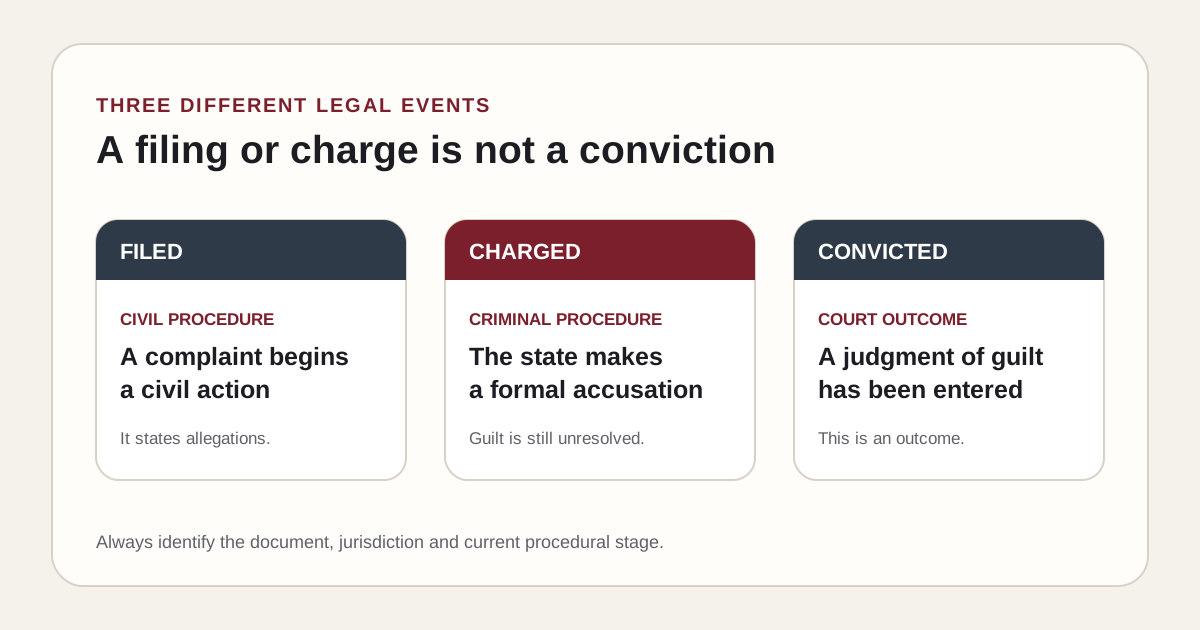
A civil action starts when a complaint is filed and the required fee is paid 1.
The state has made a formal accusation through the applicable charging instrument 3,6.
A court has entered a judgment of guilt 3.
- Civil filings, US district courts, year to 30 September 2025
- 303,563 4
- Criminal defendants convicted, US district courts, same year
- 76,514 of 82,042, excluding transfers to other districts (93 percent) 4
- Of those convicted, pleaded guilty
- 75,151 4
- Crown Court guilty plea rate, England and Wales, April to June 2026
- 61% 7
- US standard of proof, criminal
- Beyond a reasonable doubt 2
- US standard of proof, civil
- Preponderance of the evidence 1
What filed means
A civil action in the US federal courts begins when a party files a complaint and pays a filing fee required by statute 1. The complaint describes the plaintiff's damages or injury and explains how the defendant caused the harm 1. The US courts glossary defines a civil complaint as a written statement filed by a plaintiff initiating a case 3.
A filed complaint is one side's account. The defendant responds with an answer, the formal written statement that responds to a complaint 3. At trial the plaintiff must convince the jury by a preponderance of the evidence 1. Many cases end before trial. The federal courts encourage mediation, arbitration and other forms of alternative dispute resolution, and litigants often agree to a settlement 1.
In the 12 months to 30 September 2025, 303,563 civil cases were filed in the US district courts, up 4 percent on the year before 4.
What charged means
Only the government starts a federal criminal case in the United States, usually through the US attorney's office 2. An indictment is the formal charge issued by a grand jury stating that there is enough evidence of a crime 3. A grand jury is a body of 16 to 23 citizens who listen to evidence of criminal allegations presented by prosecutors 3. An information is a formal accusation by a government attorney that the defendant committed a misdemeanor 3. A criminal complaint is a sworn document filed by the government alleging a crime has been committed 3.
In England and Wales, a person who is charged receives a charge sheet that sets out the details of the crime 6. Police may release the person on bail until the court hearing or keep them in custody 6. The first hearing after charge is at a magistrates' court, even if the trial will later be at the Crown Court 6.
Prosecutors in England and Wales apply the Full Code Test, which has an evidential stage and a public interest stage 5. The evidential stage asks whether there is enough evidence to provide a realistic prospect of conviction 5. The Code says this differs from the test a court applies, as a court may only convict if it is sure that the defendant is guilty 5.
What convicted means
A conviction is a judgment of guilt against a criminal defendant 3. In US federal court the defendant must be found guilty beyond a reasonable doubt, and defendants do not have to prove their innocence 2. An acquittal is a jury verdict that a criminal defendant is not guilty 3. If a federal defendant is found not guilty, the defendant is released and the government may not appeal 2.
Most federal convictions come from guilty pleas. In the 12 months to 30 September 2025, US district courts reported terminations for 82,042 criminal defendants, excluding defendants transferred to other districts. Of these, 76,514 (93 percent) were convicted, and 75,151 of them pleaded guilty 4.
In England and Wales, the Crown Court guilty plea rate was 61% in April to June 2026. The rate counts defendants who pleaded guilty to all counts as a share of all defendants who entered a plea 7.
The terms side by side
| Term | What it is | What it is not |
|---|---|---|
| Civil complaint (US) | Written statement filed by a plaintiff initiating a case 3 | Not a finding. The plaintiff must still prove the case by a preponderance of the evidence 1 |
| Indictment (US) | Formal charge issued by a grand jury 3 | Not a verdict. Guilt must be shown beyond a reasonable doubt 2 |
| Charge (England and Wales) | Formal accusation set out on a charge sheet 6 | Not a conviction. A court may only convict if it is sure of guilt 5 |
| Plea bargain (US) | Defendant pleads guilty in return for the government dropping certain charges or recommending a lenient sentence 2 | Not an acquittal. The defendant pleads guilty 2 |
| Conviction | Judgment of guilt against a criminal defendant 3 | Not the sentence, which is the punishment the court orders after conviction 3 |
| Acquittal (US) | Jury verdict that a criminal defendant is not guilty 3 | Not open to appeal by the government in federal court 2 |
| Dismissal with prejudice (US) | Court action that prevents an identical lawsuit or criminal charges from being filed later 3 | Not the same as dismissal without prejudice, which allows a later filing 3 |
Common questions
Does being charged mean someone is guilty?
No. A charge is a formal accusation. In US federal court, defendants do not have to prove their innocence and guilt must be shown beyond a reasonable doubt 2. In England and Wales, a court may only convict if it is sure that the defendant is guilty 5.
What is the difference between an indictment and an information?
An indictment is a formal charge issued by a grand jury. An information is a formal accusation by a government attorney that the defendant committed a misdemeanor 3.
What does it mean when a headline says someone was sued?
It means a civil complaint was filed. A civil action begins when a party files a complaint and pays a filing fee 1. The case may then settle, be dismissed or go to trial 1,3.
How many US federal criminal cases end in conviction?
In the 12 months to 30 September 2025, 76,514 of 82,042 defendants whose cases ended, excluding transfers to other districts, were convicted, 93 percent. Of those, 75,151 pleaded guilty 4.
Rules and charges change. Check the official source linked on this page before you pay or travel. Spotted an error? Email hello@enforcementoutcomes.com.
Sources
- Administrative Office of the U.S. Courts: Civil Cases
- Administrative Office of the U.S. Courts: Criminal Cases
- Administrative Office of the U.S. Courts: Glossary
- Administrative Office of the U.S. Courts: U.S. District Courts Judicial Business 2025
- Crown Prosecution Service: The Code for Crown Prosecutors (26 October 2018)
- GOV.UK: Being charged with a crime
- Ministry of Justice: Criminal court statistics quarterly: April to June 2026 (24 September 2026)
Related
- What happens after a charge
The steps from charge to verdict and sentence in England and Wales, the US federal courts and Australia, with official plea, conviction and timing data.
- Criminal investigation stages compared
From report to charge: how England and Wales, the US federal system and Canada move from investigation to a decision to prosecute.
- How civil lawsuits usually end
Most civil cases end without a trial. Official US federal court and England and Wales County Court figures on settlements, defaults and trials.
- Settlements without admission explained
What neither admit nor deny settlements mean, the SEC's May 2026 change, and how the FCA, EU, ASIC and French prosecutors treat admissions.
- Appeals and overturned decisions
What affirmed, reversed, remanded and quashed mean, and how often appeals succeed in US federal courts, the EU Court of Justice and English criminal cases.